A Year of Action: GuardIAS and OneSTOP’s First Year Tackling Invasive Alien Species Across Europe
Authored by Grace Windsor from the Irish Ocean Literacy Network, Nadya Denkova from Pensoft Publishers, Stelios Katsanevakis from the University of the Aegean, Quentin Groom from Meise Botanic Garden and Helen Roy from the UK Centre for Ecology and Hydrology.
Invasive alien species (IAS) don't respect borders. They move through water, air, soil, and supply chains — and they're reshaping European ecosystems faster than current technologies can track. In early 2025, two Horizon Europe projects were launched to tackle the threat of invasive alien species: GuardIAS, focusing on aquatic IAS in freshwater and marine environments, and OneSTOP, targeting terrestrial IAS. Both projects use advanced scientific research, cutting-edge technology, and artificial intelligence to develop new tools and methods that will prevent, detect, prioritise, eradicate, and manage invasive alien species — covering all steps of the biological invasion process. In addition, public engagement is a significant aspect of both projects, taking form in five Living Labs in OneSTOP and eleven case studies in GuardIAS.
Here’s where the two projects stand a little bit over a year after their kick-off:
GuardIAS works for the prevention, detection, control and dissemination of underwater IAS
GuardIAS is using AI to predict species introductions and invasiveness by analysing biological traits, distributions, and environmental tolerances drawn from global datasets. Risk modelling identifies high-risk pathways and at-risk locations, accounting for the influence of global trade and climate change. In addition, GuardIAS is exploring nature-inspired, non-toxic coatings to reduce biofouling on ships — one of the primary vectors for aquatic species spread. Together, these tools are designed to give decision-makers earlier, smarter options for prevention.
Detection activities underwater in the past year included the first pom-pom sampling campaign for Rugulopteryx okamurae, a seaweed native to the northwestern Pacific that is now invasive and spreading along Atlantic coastlines as a species of European Union concern. In the Netherlands, marbled crayfish are being tracked to understand their spread and inform management. Further north, pink salmon detection is scaling up in Northern Norway as this Pacific invader spreads into new European rivers. Another case study is tracking the macroalga, Undaria pinnatifida (wakame), while work on the African clawed frog is refining identification tools for a notoriously difficult species to monitor.
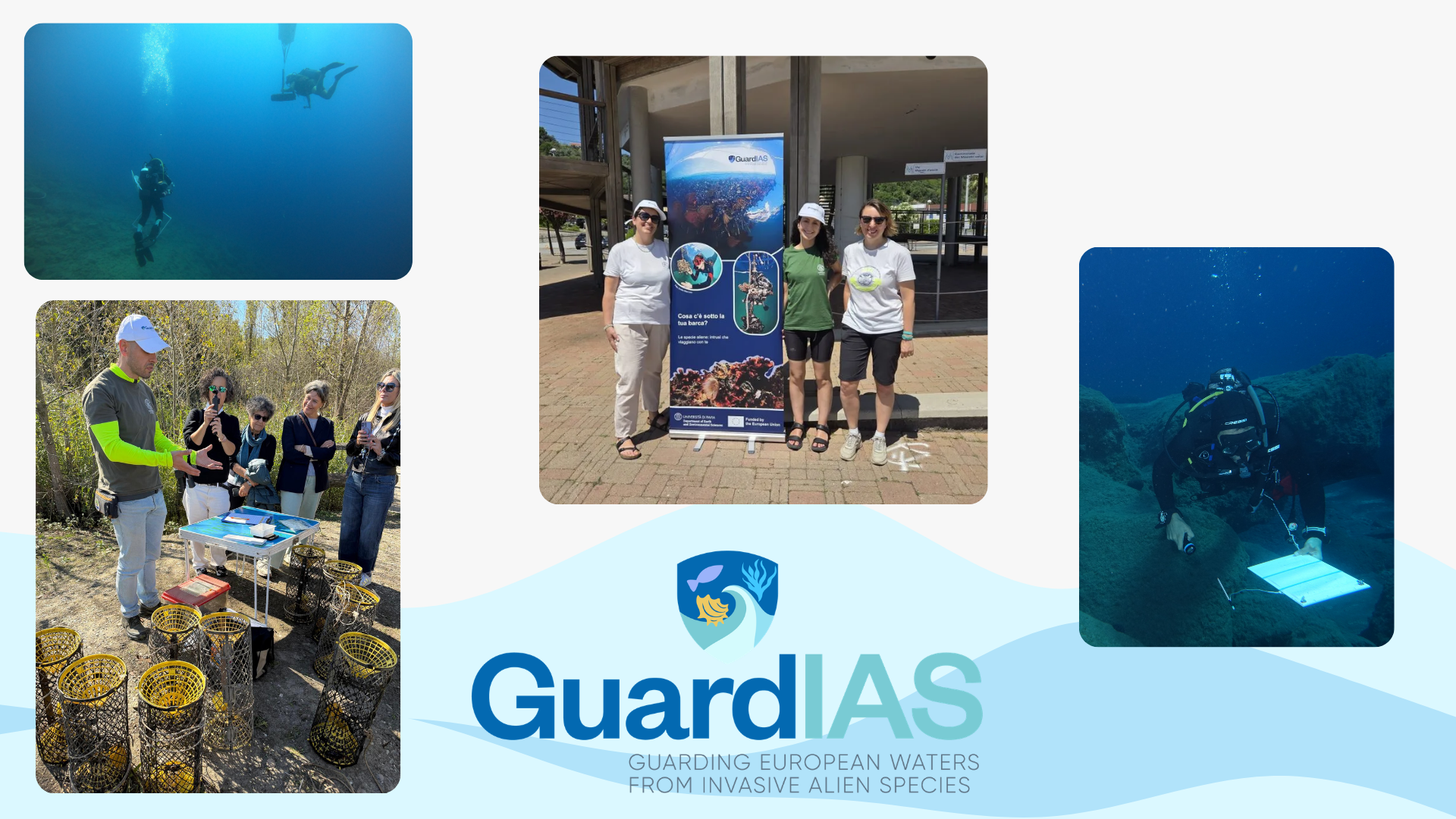
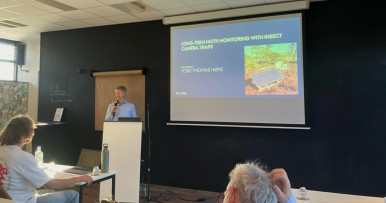
GuardIAS activites over the past year
In parallel, four of the GuardIAS case studies run active management trials. In Italy, red swamp crayfish control methods are being evaluated in real freshwater conditions. In Flanders, a prioritisation framework for bullfrog control is guiding where and when to intervene. In Greece, lionfish removal campaigns are engaging citizens while promoting the species for consumption. And in Tuscany, GuardIAS is evaluating management effectiveness for parrot's feather — a widespread aquatic plant with limited control options to date.
On the socio-economic level, the inaugural virtual GuardIAS Conference, in collaboration with INVASIVESNET, brought together researchers, policymakers, and practitioners online for a global conversation on aquatic IAS. Marina events for boaters and marina personnel engaged a community that moves species across waterways without always knowing it. In Lombardy, social performing arts brought river biodiversity to life for local communities. And the first GuardIAS MOOC attracted 169 participants from 20 countries.
OneSTOP works on detection, prioritisation, dissemination and socio-political action in relation to terrestrial IAS
On the ground, detection work includes testing insect camera traps (AMI traps) and car-mounted camera traps (CamAlien) in the project’s Living Labs. Moreover, model maps are available from CamAlien data, designed for visual inspection of machine-learning-based predictions for IAS plants, has been launched.
OneSTOP is also working on modelling invasive alien species and their impacts and exploring approaches for making predictions using horizon scanning. Over the past year, a key achievement has been the creation of a gallery of species distribution model maps. The gallery shows model maps for 120 terrestrial invasive alien species for historical conditions and future periods, each available for three of the widely recognised by the IPCC climate-society scenarios.
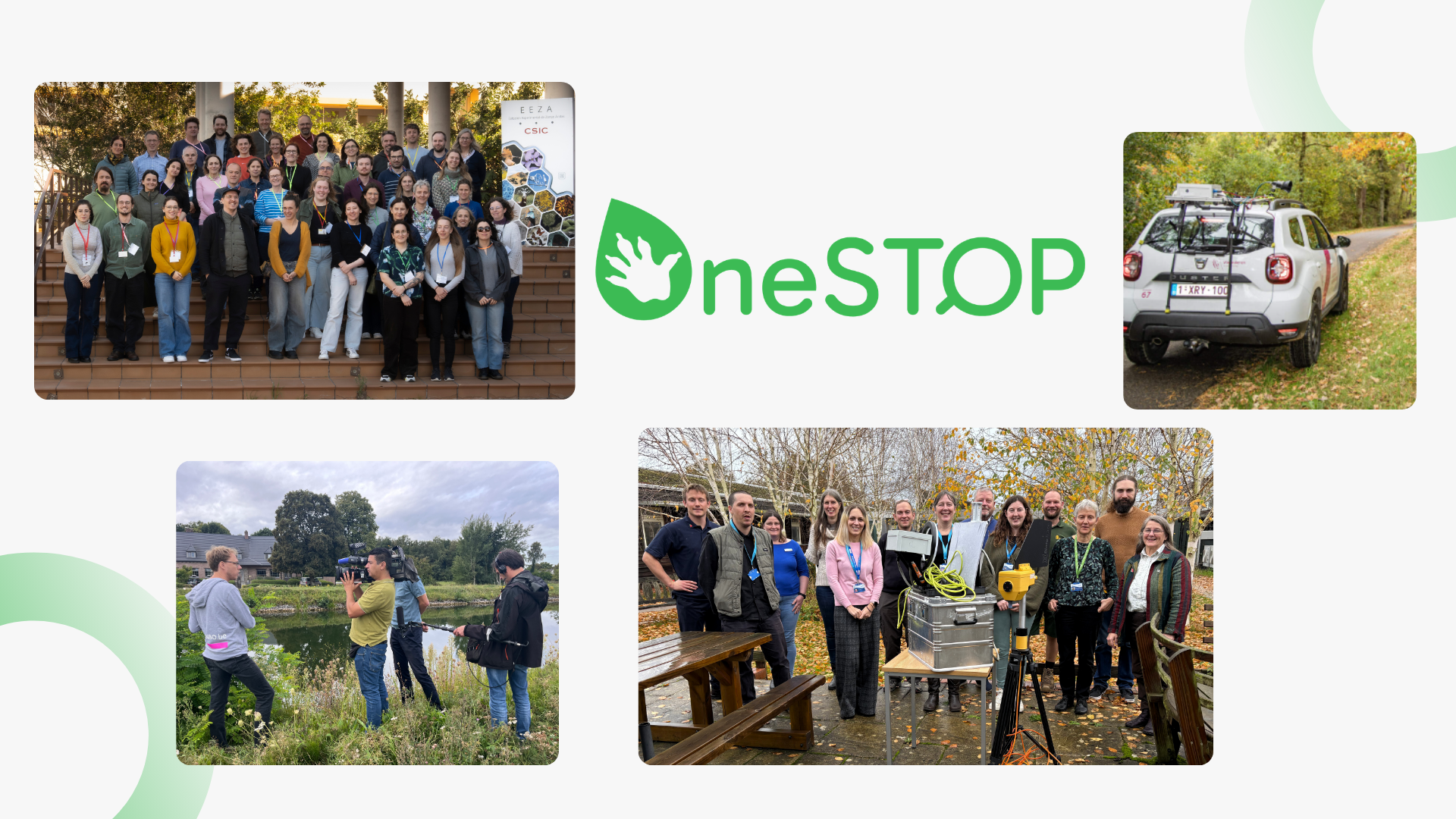
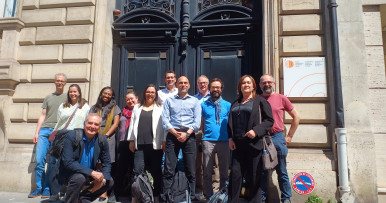
OneSTOP activities from the past year
In parallel, work on the generation of an open and reproducible workflow to make detection data available on GBIF and other repositories, and on improving the workflows for generating national and European lists of introduced and invasive species is also underway. In November 2025 OneSTOP organised a Datathon during which we worked on 9 checklists of introduced and invasive species.. The list for Belgium has already been updated on GBIF, and updates are upcoming for Cyprus, Romania and Portugal.
OneSTOP’s socio-political work focuses on analysing socio-economic factors affecting IAS spread in order to address concerns and misconceptions about them. Over the past year, culturomics has been used to screen and investigate media (Wikipedia, YouTube) in relation to public perceptions towards IAS. In parallel, OneSTOP is also working on creating a blueprint to support the implementation of EU IAS Regulations and Target 6 of the Global Biodiversity Framework through case studies.
What lies ahead
Both projects have been working together on developing an Early Alert System for new IAS introductions, which will ensure that what's detected in the field travels quickly to the people who need to act on it. In addition, OneSTOP and GuardIAS have been collaborating on developing a joint modelling framework for making predictions on IAS spread and impact.
Looking ahead, GuardIAS is developing the GuardIAS Intelligence Analyst System (G.I.A.S.) and will eventually provide a dedicated tool for data gathering and knowledge synthesis across the project.
In parallel, OneSTOP is working on creating repeatable workflows for iEcology data mining, horizon scanning of species in order to generate a prioritised list of species, as well as workflows to automate and dynamically model potential current and future distributions of IAS. In addition, work is in progress to facilitate EICAT assessment using large language models and to create a dashboard allowing immediate feedback from AMI traps to the Living Labs on the detection of insects. Moreover, native species classified as threatened by IAS in the IUCN Red List at the European level have been compiled, and the next steps are creating models for their distributions to understand how they may be impacted by IAS in the future.