What happened in OneSTOP’s first year: Insights from our Annual Meeting 2026
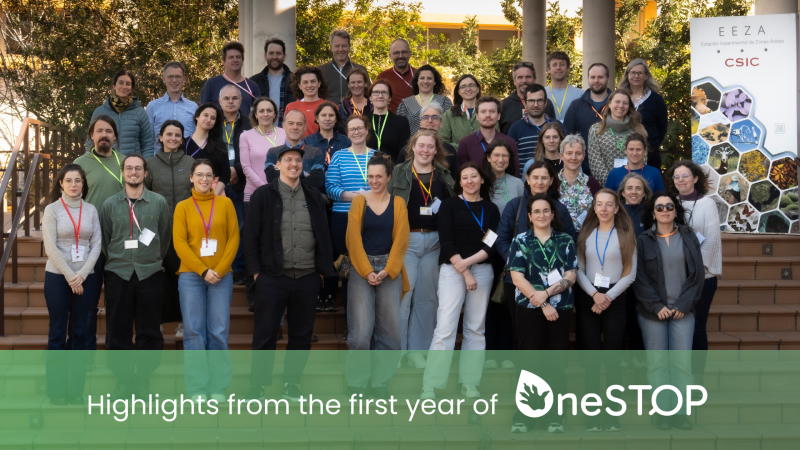
A year after the project’s kick-off, OneSTOP’s consortium got together in Almeria, Spain at the EEZA-CSIC (Experimental Station of Dry Areas) between 19 and 22 January 2026. The meeting began with an overview of progress and advances for each work package and continued with discussions on the next steps of the project’s development. It also featured a field trip to the Cabo de Gata-Níjar Natural Park, the largest protected coastal area in Andalusia, providing a suitable backdrop to reflect on how strengthened IAS management in protected areas contributes to the European objective of reducing impacts on Red List species.This first year has been eventful for our Living Labs and our four pillars: detection, prioritisation, dissemination, and socio-political action. Learn more about them in our introductory video.
Living Labs
All 5 Living Labs, located in the UK, Romania, Finland, Portugal, and Belgium, were established and have already started testing detection tools. Find out more about their work in our blogpost.
Detection
OneSTOP’s detection work focuses on camera traps for plants, insects and road-killed mammals; eDNA sampled from air; and iEcology techniques applied to social media platforms, alongside the use of private gardens as sentinel observation sites for emerging invasive alien species (IAS). Over the past year, insect camera traps (AMI traps) and car-mounted camera traps (CamAliens) have been delivered to OneSTOP’s Living Labs for testing under real-world conditions. Another key advancement in this pillar is the launch of a map service for CamAlien data, aimed at visual inspection of machine-learning-based predictions of IAS plants. Further work for the creation of a dashboard that allows immediate feedback from AMI traps to the Living Labs on the detection of insects is in progress. In parallel, work is underway to establish repeatable iEcology data mining workflows and to assess the value of iEcology data for IAS early-warning systems, with results to be shared publicly in the coming months.
Prioritisation
In the prioritisation pillar, OneSTOP is working on creating a data-driven prioritisation system, which includes modelling invasive alien species and their impacts and also exploring approaches for making predictions using horizon scanning. Over the past year, a key achievement has been the creation of a gallery of species distribution model maps. The gallery shows model maps for 120 terrestrial invasive alien species for historical conditions and future periods, each available for three of the widely recognised by the IPCC climate-society scenarios. The model maps are at 1 km resolution across Europe and allow for comparing the different scenarios. Over the next year, a repeatable workflow for horizon scanning of species, allowing the generation of a prioritised list of species, will be developed. Further work on creating workflows to automate and dynamically model potential current and future distributions, and a framework for prioritisation of IAS in the EU, is underway. In parallel, native species classified as threatened by IAS in the IUCN Red List at the European level have been identified, and the next steps are creating models for their current and future distributions.
Dissemination
As data is crucial for effective management of IAS, OneSTOP is working on generating an open and reproducible workflow to make detection data available on GBIF and other repositories, and on improving the workflows for generating national and European lists of introduced and invasive species (IIS). The first steps in this direction were made in November 2025, when OneSTOP organised a Datathon during which 9 checklists of introduced and invasive species were discussed. These lists will be used for the creation and update of national lists of invasive and introduced species. The list for Belgium has already been updated, and updates are upcoming for Cyprus, Romania and Portugal. Further work for setting up a European early alert system for new IAS introductions and creating a workflow to facilitate EICAT assessment using large language models is also underway.
Socio-political action
OneSTOP’s socio-political work focuses on analysing socio-economic factors affecting IAS spread in order to address concerns and misconceptions about them. Over the past year, culturomics has been used to screen and investigate media (Wikipedia, YouTube) in relation to public perceptions towards IAS. Concurrently, the correlation between social media engagement and general media coverage is being analysed, and a community opinion paper regarding the constraints of using social media in IAS research is underway. In parallel, OneSTOP is working on creating a blueprint to support the implementation of EU IAS Regulations and Target 6 of the Global Biodiversity Framework through case studies. We are considering ways in which we can ensure effective communication of research outputs that have value for informing decision-making.